
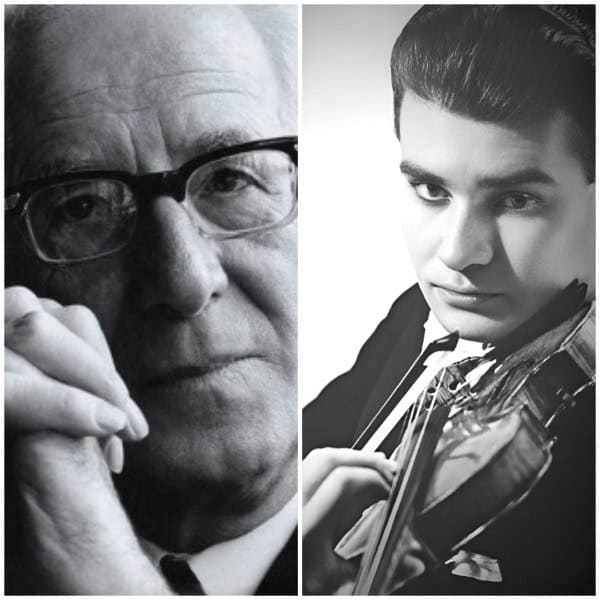
Another historic concert this weekend – the legendary French violinist Christian Ferras joining Eugen Jochum and Orchestre National de Radio France in a concert from Théåtre des Champs-Élysées on April 9, 1964 and broadcast live by ORTF in Paris and performing Tchaikovsky’s Violin concerto op. 35.
Christian Ferras was born at Le Touquet in 1933. He began studying the violin with his father. He entered the Conservatoire de Nice as a student of Charles Bistesi in 1941, and in 1943 obtained the First Prize. In 1944 he went to the Conservatoire de Paris. In 1946 he won the First Prize in both disciplines (violin and chamber music), and started his performing career with the Pasdeloup Orchestra under Albert Wolff, and later Paul Paray. He worked with Romanian violinist and composer George Enescu, who also acted as an instructor.
The Violin Concerto by Federico Elizalde was premiered by Ginette Neveu in Paris in 1944, but Christian Ferras gave its London premiere under the direction of Gaston Poulet, in the presence of the composer, and made the world premiere recording on 7 November 1947, at the age of 14. In 1948 Ferras won First Prize at the international Scheveningen Festival; Yehudi Menuhin was among the judges. He premiered Arthur Honegger’s Sonata for Solo Violin in the Salle Gaveau on 16 November 1948. The next year, he won the second prize (the first prize was not awarded) in the international Marguerite Long-Jacques Thibaud Competition. It was there that he met Pierre Barbizet, with whom he formed one of the most famous partnerships in the history of piano-violin collaboration. In 1950 he, along with Jean-Pierre Rampal and George Enescu, recorded various works by J.S. Bach. It was at this point that his career took off when he was invited by Karl Böhm to play with the Berlin Philharmonic in 1951. He subsequently gave a series of concerts in, amongst other places, Japan and South America.
In 1952, he premiered both Claude Pascal’s violin sonata, and (with Pierre Barbizet), he premiered Double Concerto by Ivan Semenoff. In 1954, he recorded Brahms’s Violin Concerto with Carl Schuricht. 1959 was a year in which Ferras rose to real prominence: he began his career in the United States by playing Brahms’s concerto under Charles Munch; recorded Bach’s Double Concerto with Yehudi Menuhin; played at the Prades Festival with Pablo Casals and Wilhelm Kempff; and premiered Gyula Bando’s Violin Concerto.
In 1960 he premiered Serge Nigg’s Concerto, which the composer is said to have written “for the violin and not without the violin”. In 1965 he enjoyed a much acclaimed tour through Southern Africa with accompanist Jean-Clause Ambrosini.
Christian Ferras struggled with severe lifelong depression. He committed suicide in Paris on 14 September 1982, aged 49.
Eugen Jochum was a regular recording artist, from his first records in 1932. In the stereo LP era, he recorded mainly for Deutsche Grammophon. His DG cycle of the symphonies of Anton Bruckner, split between the Berlin Philharmonic and Bavarian Radio Symphony Orchestra, has remained in the record catalogs ever since its first issue in the 1960s. This cycle and a later Jochum Bruckner cycle, with the Staatskapelle Dresden for EMI, have been widely and frequently acclaimed and have caused his name to be especially associated with this composer. In addition, he was president of the International Bruckner Society from 1950, and wrote extensively about Bruckner interpretation. Still, according to his New York Times obituary, he said in a 1983 interview, “Today, everyone thinks of me as a specialist in Bruckner’s symphonies. But I began with the music of Bach, Mozart and Beethoven. And it is to their music that I still feel closest.” His recordings of Bach’s Mass in B minor and St. John Passion are frequently counted among the finest of these works. His three complete recordings of the Beethoven symphonies have also been strongly praised: they were made with the Berlin Philharmonic and Bavarian Radio Symphony Orchestra in the 1950s for Deutsche Grammophon, with the Royal Concertgebouw Orchestra in the late 1960s for Philips, and with the London Symphony Orchestra in the 1970s for EMI. Jochum also made two complete recordings of the symphonies of Johannes Brahms, one with the Berlin Philharmonic in the mid-1950s, the other with the London Philharmonic in 1977. On the strengths of these sets, the conductor Kenneth Woods called him “the greatest Brahms conductor who ever lived.” (Others would nominate Weingartner or Toscanini.) He also recorded the Brahms piano concertos with Emil Gilels, a recording that is often listed among the finest made of these works. His recordings of Mozart, Haydn, Schumann, Wagner and Carl Orff have also been highly praised. His 1967 recording of Carmina Burana is considered by Bill Alford to be an authoritative interpretation, as Orff himself was present during the recording and endorsed the finished product.
Enjoy the performance.
